Interactive guide · English
Rules of pickleball 2026
Learn the rules through practice: explore our resources, complete five missions and then check what changes in 2026.
Start here
Choose how you want to learn
Video, audio, slides and infographics turn the rules into clear decisions. Original media and downloads are in Spanish. Previews are public; downloads require a free account.
Video and audio
Learn at your own pace
Play the Spanish originals on this page, without autoplay. The translated chapter index helps you find topics or review the content without playing it.
Explainer video · Spanish · 9:34
2026 official rules · Spanish video
An explanatory video accompanying the guide, with a text index and no autoplay. Original audio in Spanish. You can read the chapter index below the player.
- 00:00Why the rulebook existsAuthority, fair play and a shared basis for decisions.
- 01:12Court and equipmentDimensions, net, paddles and balls.
- 02:38Serving and two bouncesThe opening sequence and service requirements.
- 04:46The kitchen and volleysContact, momentum and regaining balance.
- 06:20Calls and faultsThe benefit of the doubt and the end of a rally.
- 08:16Competition and inclusionFormats, officiating and the adaptive section.
Audio · Spanish · 22:38
Radical honesty in the rules · Spanish audio
An audio conversation about fair play, calls and difficult decisions. Original audio in Spanish. You can read the chapter index below the player.
- 00:00Radical honestyWhy a fair call protects the game.
- 03:45Give the opponent the benefit of the doubtSeeing out clearly and resolving disagreement between partners.
- 08:20Deciding under pressureRoutines for players and coaches during a match.
- 13:40Officials and spectatorsWho can intervene and why spectators do not decide.
- 18:05Practising conductExercises to turn the rules into habits.
Presentation
The rules in 15 scenes
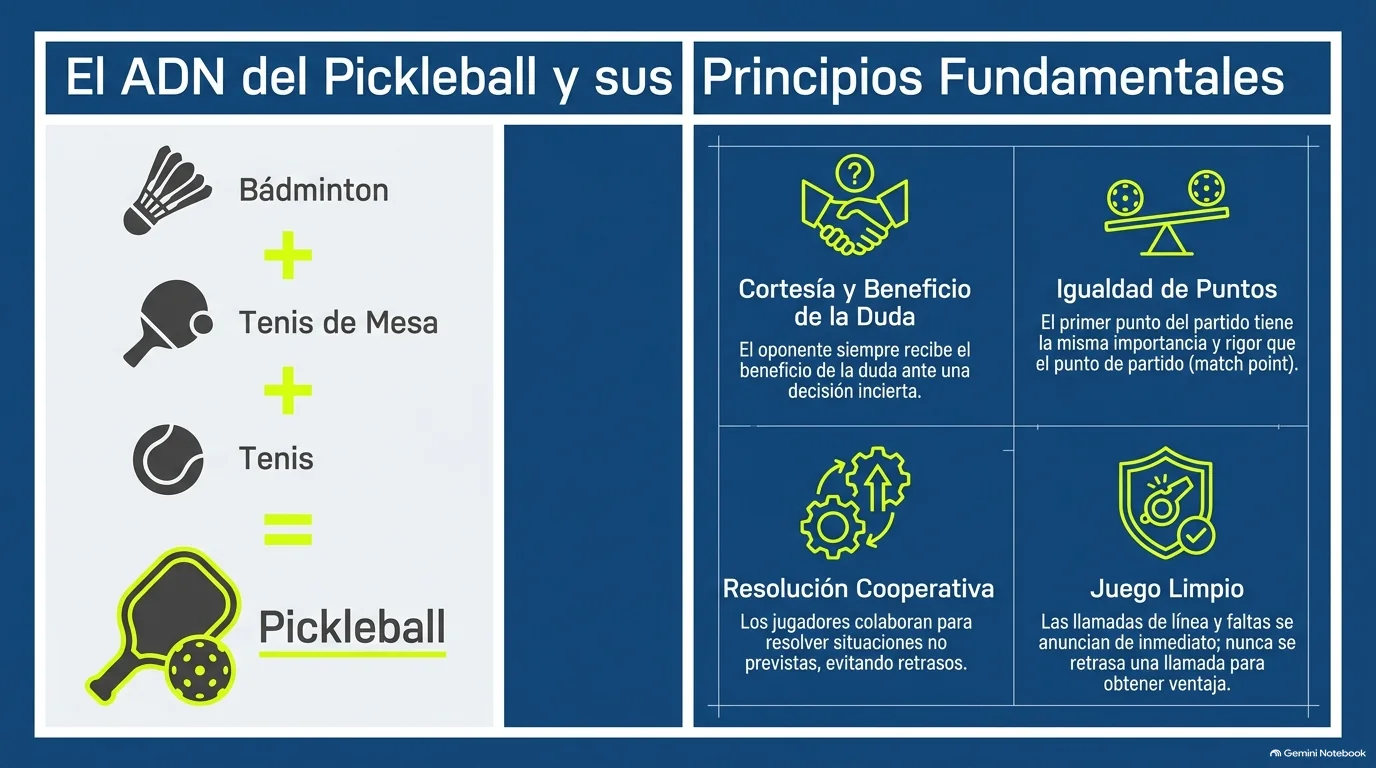
Browse the original Spanish slides using a keyboard or touch. Free PDF and PowerPoint downloads in Spanish are available with an account.
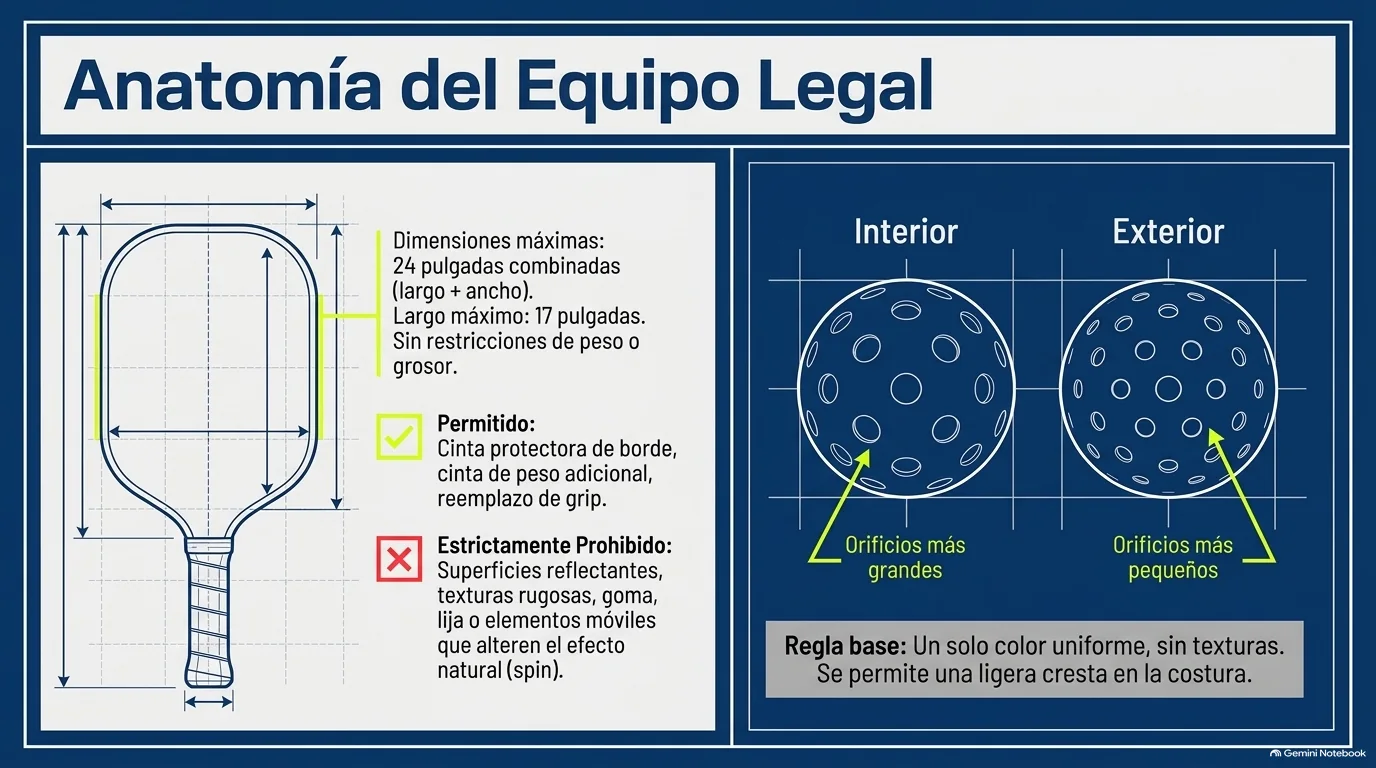
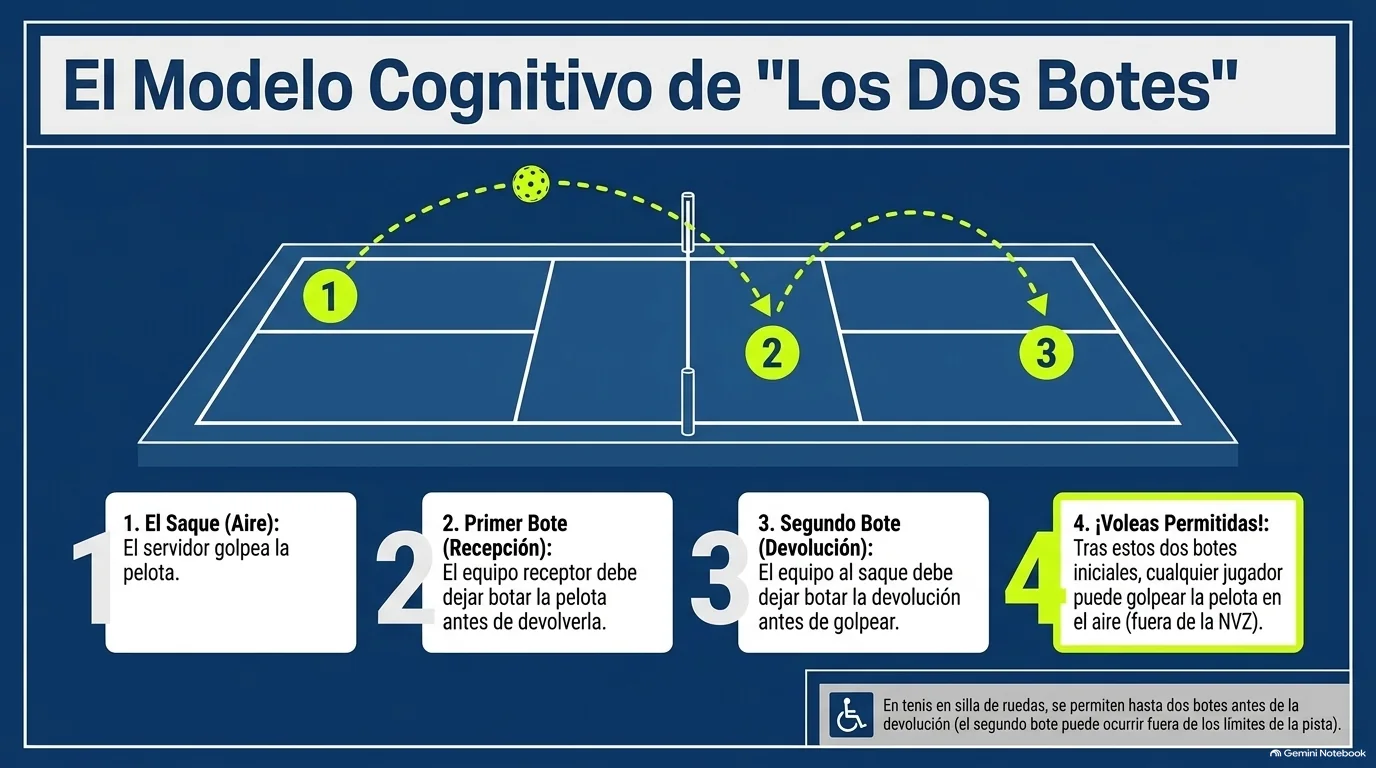
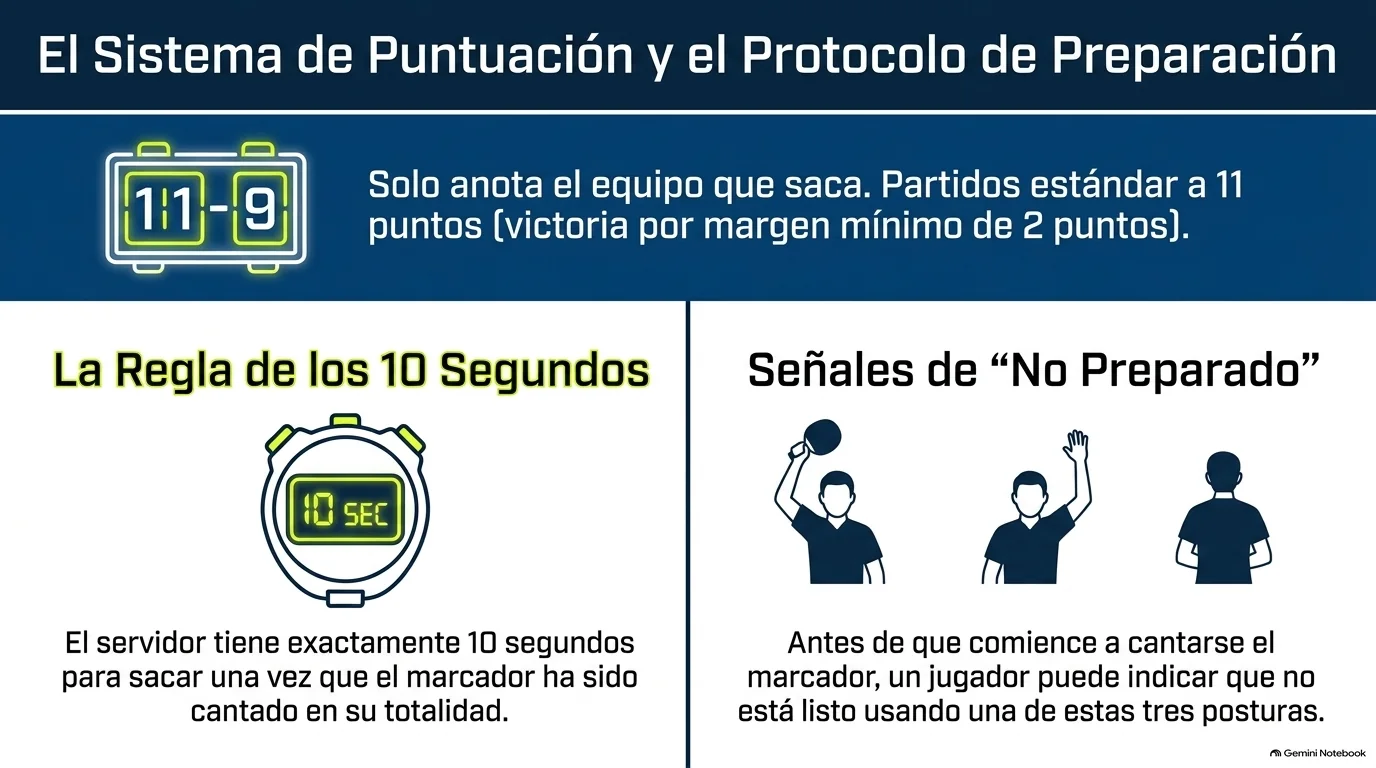
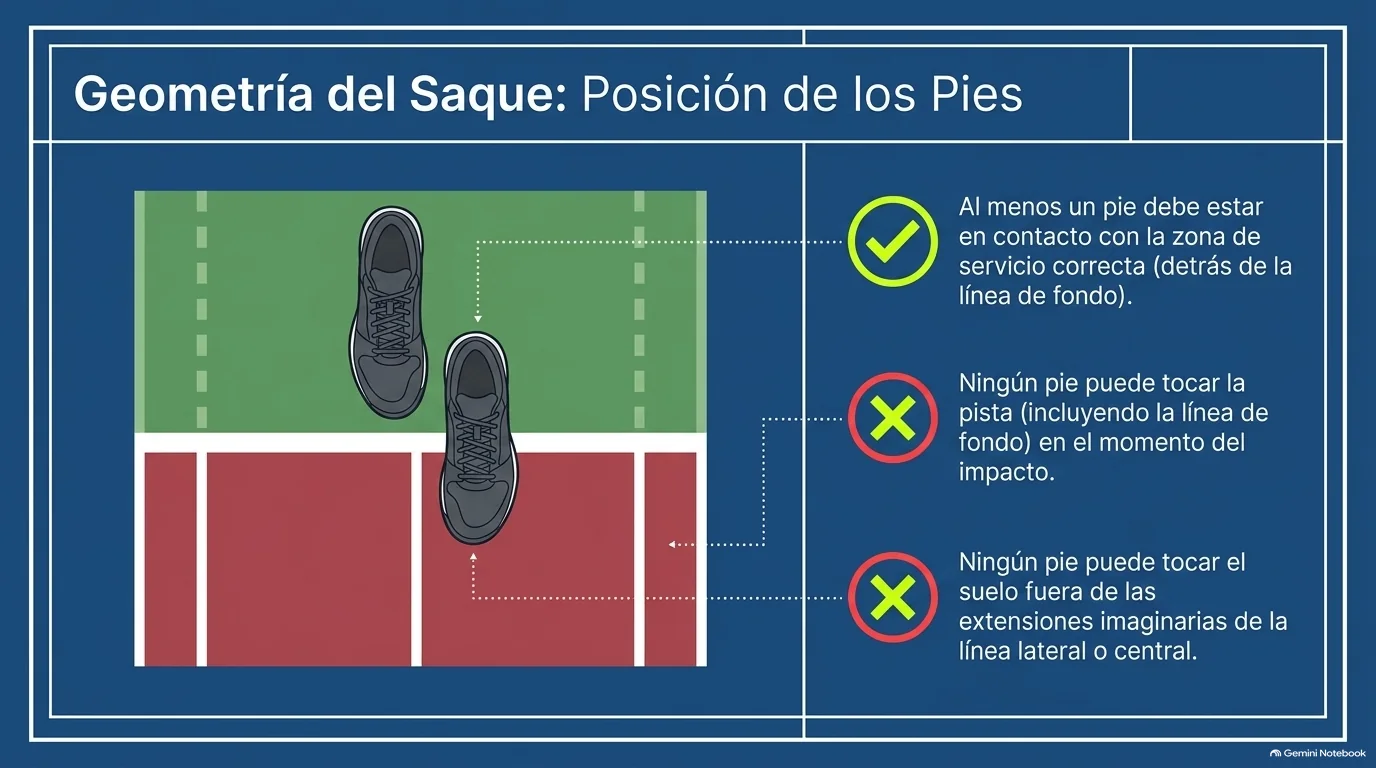
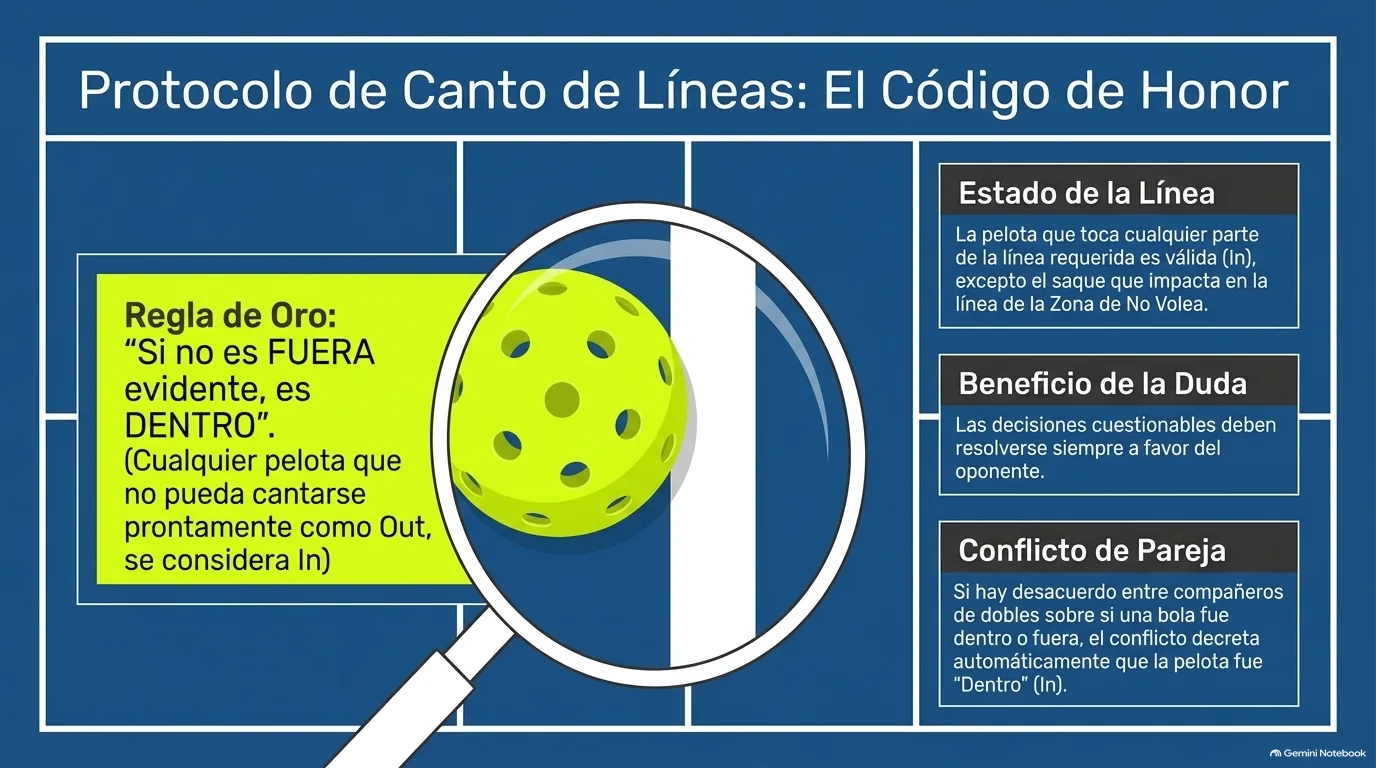
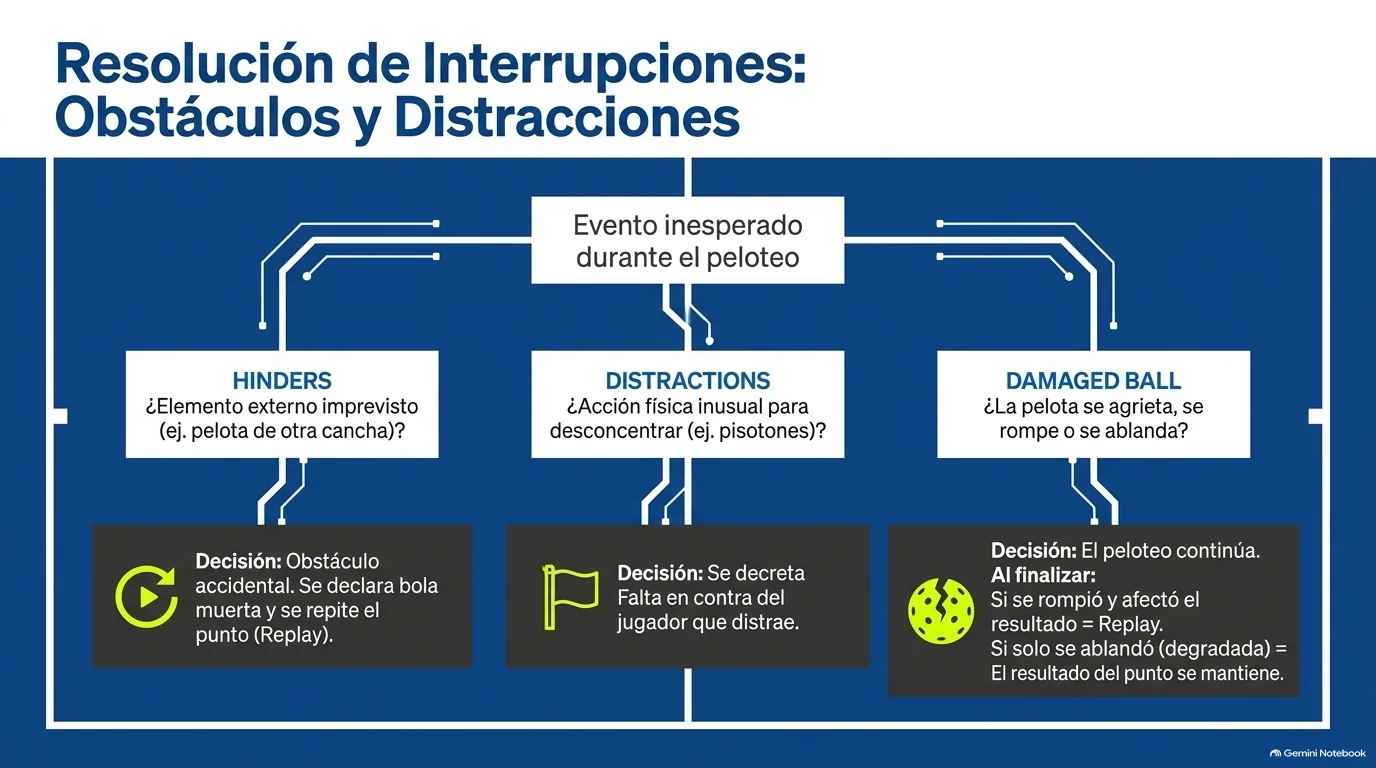
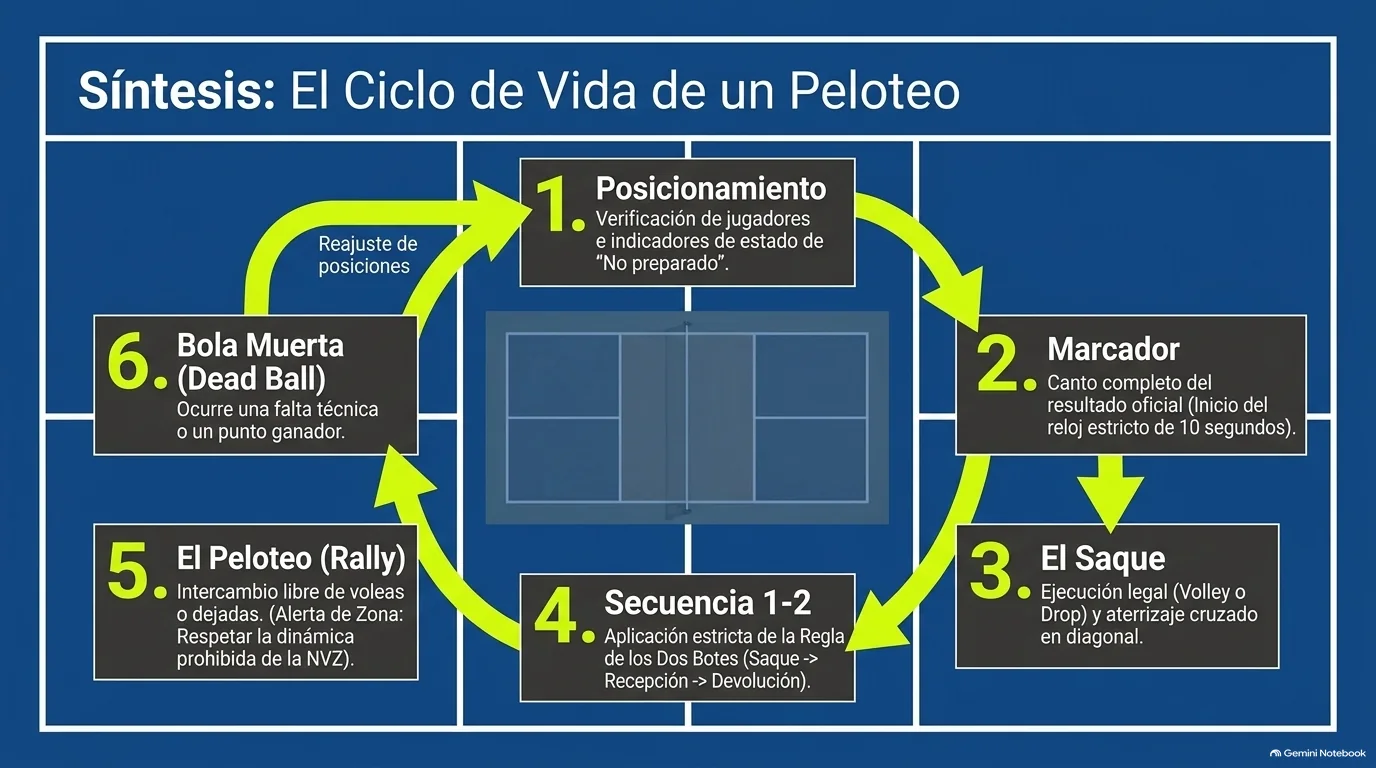
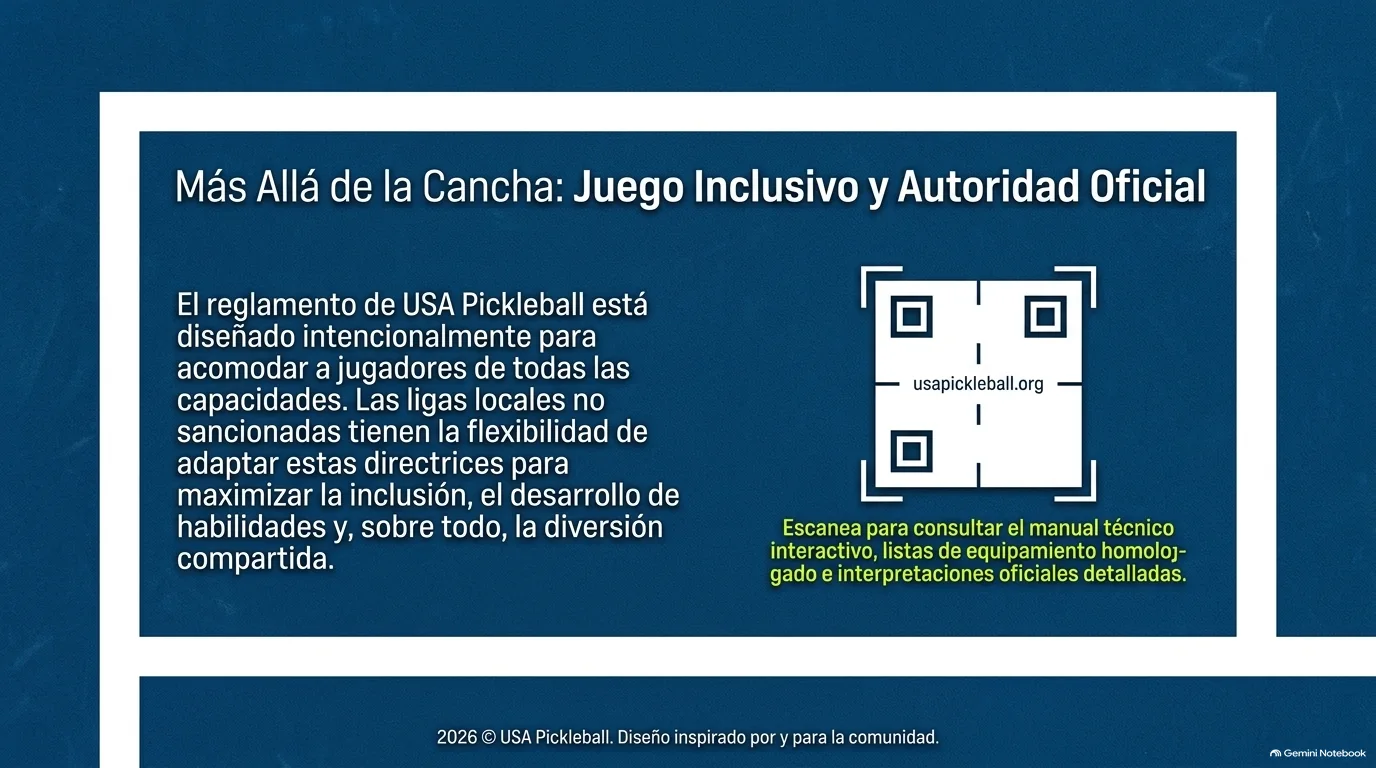
Infographics
Two views to keep
View a thematic preview and download each original Spanish infographic to use on court or during a practice session.
Six essential decisions, reviewed and corrected for this publication. Original infographic in Spanish.
A vertical guide to court, equipment, scoring and faults. Original infographic in Spanish.
Know the rules
Learn the court, mission by mission
First understand the rule, then look at a real situation and make your decision. All explanations are public; challenges, flashcards and the quiz require a free account.
Your learning board
Five missions. One court.
Score
— / 1000
Sign in to complete challenges and save your score.
Before the first serve
Get the court ready
Learn to read the court, choose equipment, call the score and position each player before putting the ball in play.
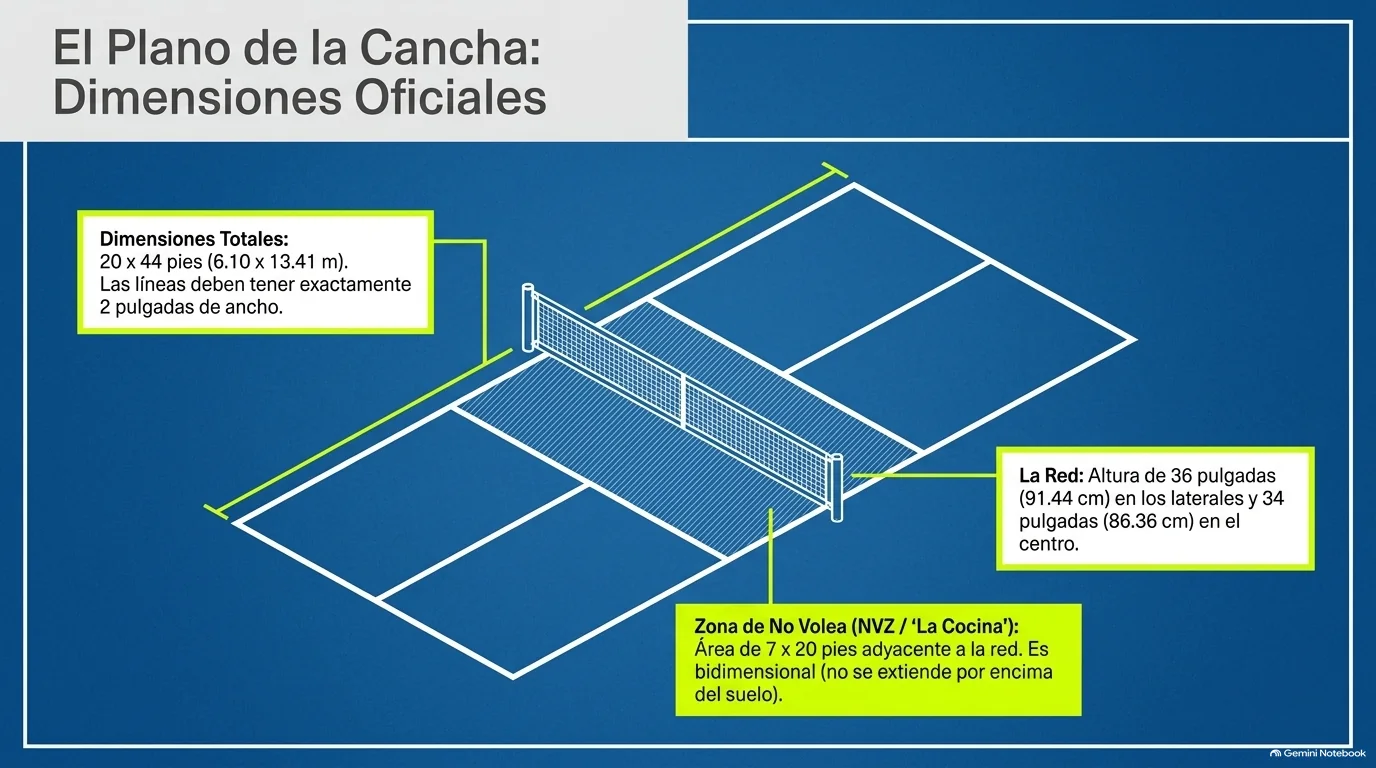
20 × 44 feet: the same court for singles and doubles
Court and equipment
The court measures 6.10 × 13.41 m. The non-volley zone extends 2.13 m on each side of the net. The net is 91.44 cm high at the sidelines and 86.36 cm at the centre.
- Lines are part of the area they define.
- The paddle must be listed as approved when the event requires it.
- The ball must be uniform and meet the specifications for indoor or outdoor use.
Situation → decision
The serve touches the outer line of the diagonal service court.
In: the baseline and sidelines belong to the service court.
Sections 2 and 3
Traditional side-out and authorised formats
Scoring
In the traditional format, only the serving team scores. A standard game is usually to 11, win by two; a tournament may announce 15, 21 or rally scoring.
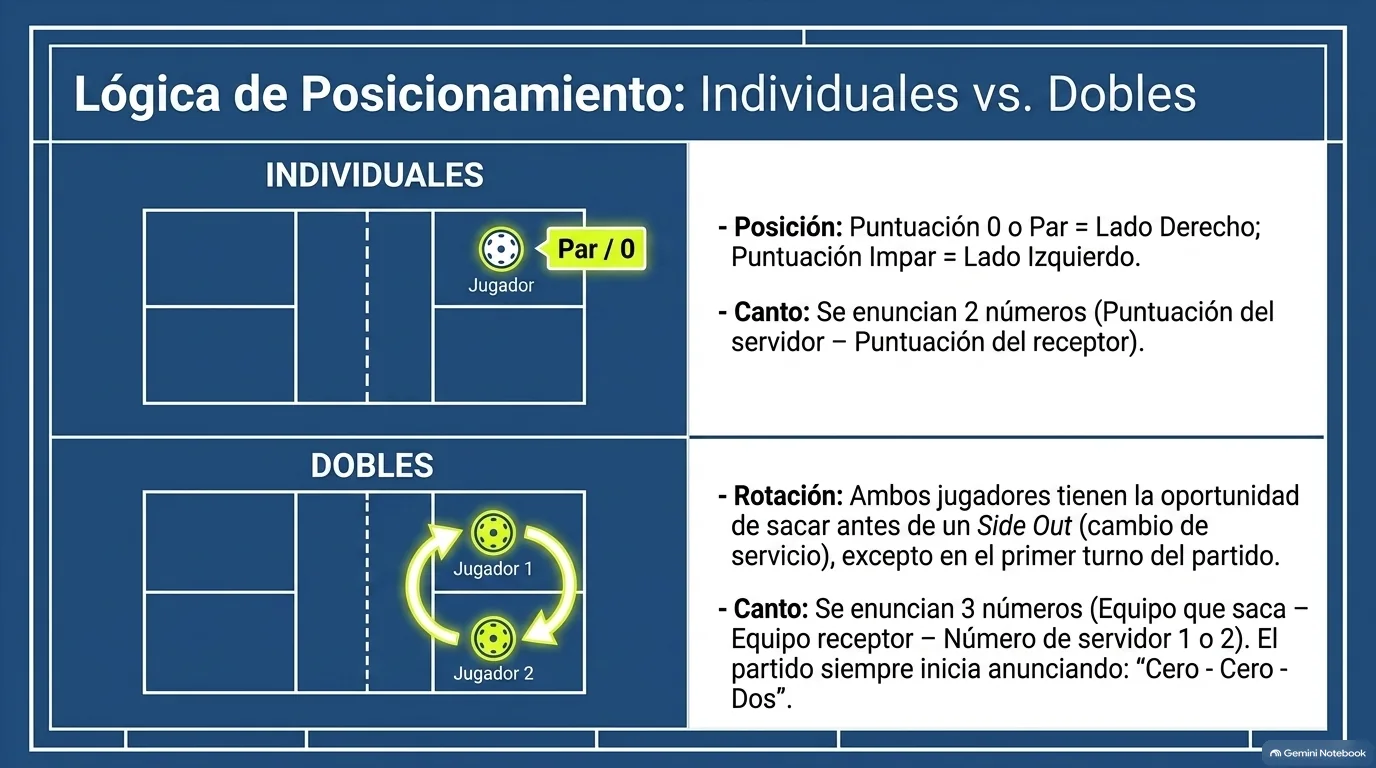
- Doubles uses three numbers: the serving team’s score, the receiving team’s score and the server number.
- Traditional side-out doubles starts at 0-0-2.
- The tournament’s published format takes precedence for that event.
Situation → decision
At 10-10, the serving team wins the next rally.
The score becomes 11-10. They have not won yet because they need a two-point lead.
Section 4 · Section 14 for rally scoring
An even or odd score guides positioning
Positions and the correct server
In singles, the server uses the right side with an even score and the left with an odd score. In doubles, each player’s starting position helps establish who should serve and receive.
- Do not change sides after losing a rally if your team has not scored.
- Before serving, you may confirm the score and server with the referee.
- Position corrections depend on exactly when the error is detected.
Situation → decision
The serving team has 6 points and its starting player is about to serve.
The player must be in the right service court because six is even.
Sections 4 and 6
Serving and the two bounces
Put the ball in play
Understand both types of serve, foot positioning, the correct service court and the sequence that prevents volleying too early.
Visible, diagonal and within ten seconds
Serving
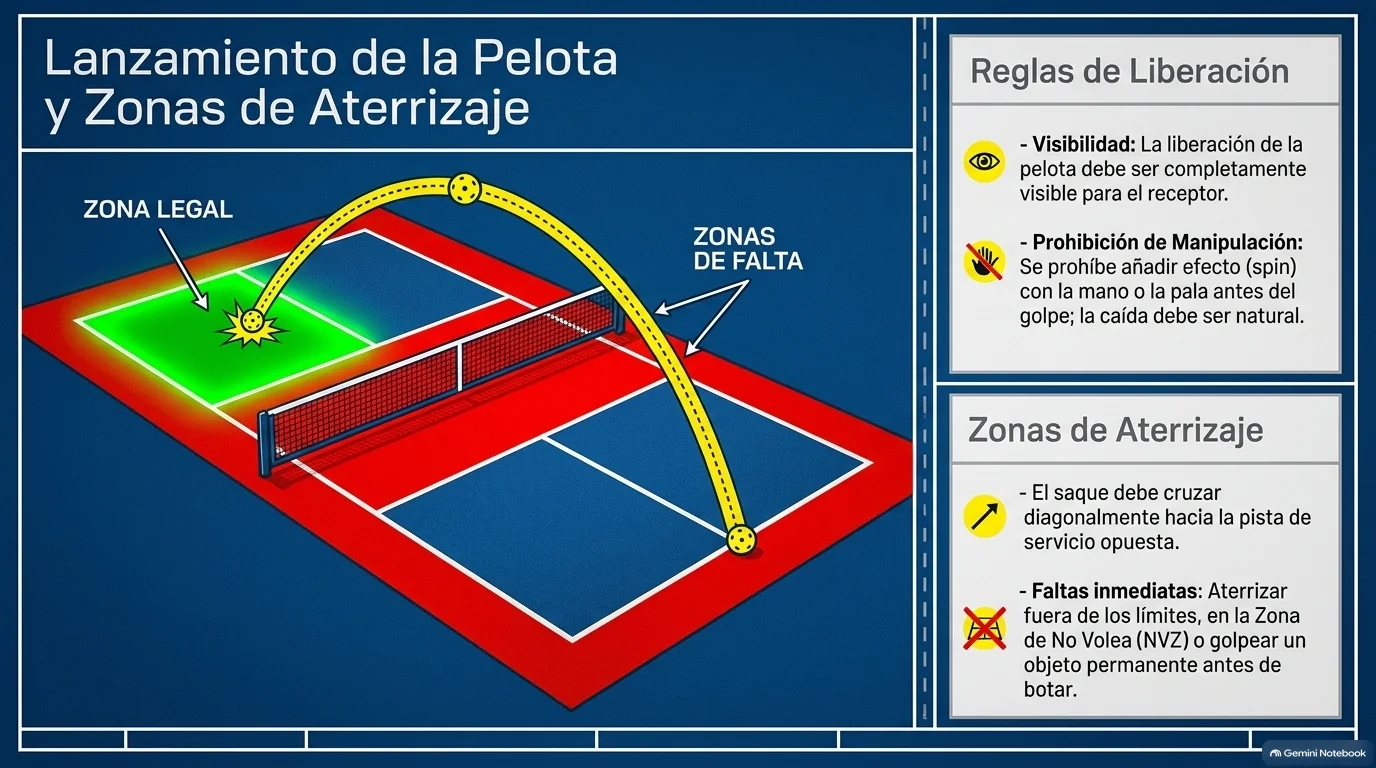
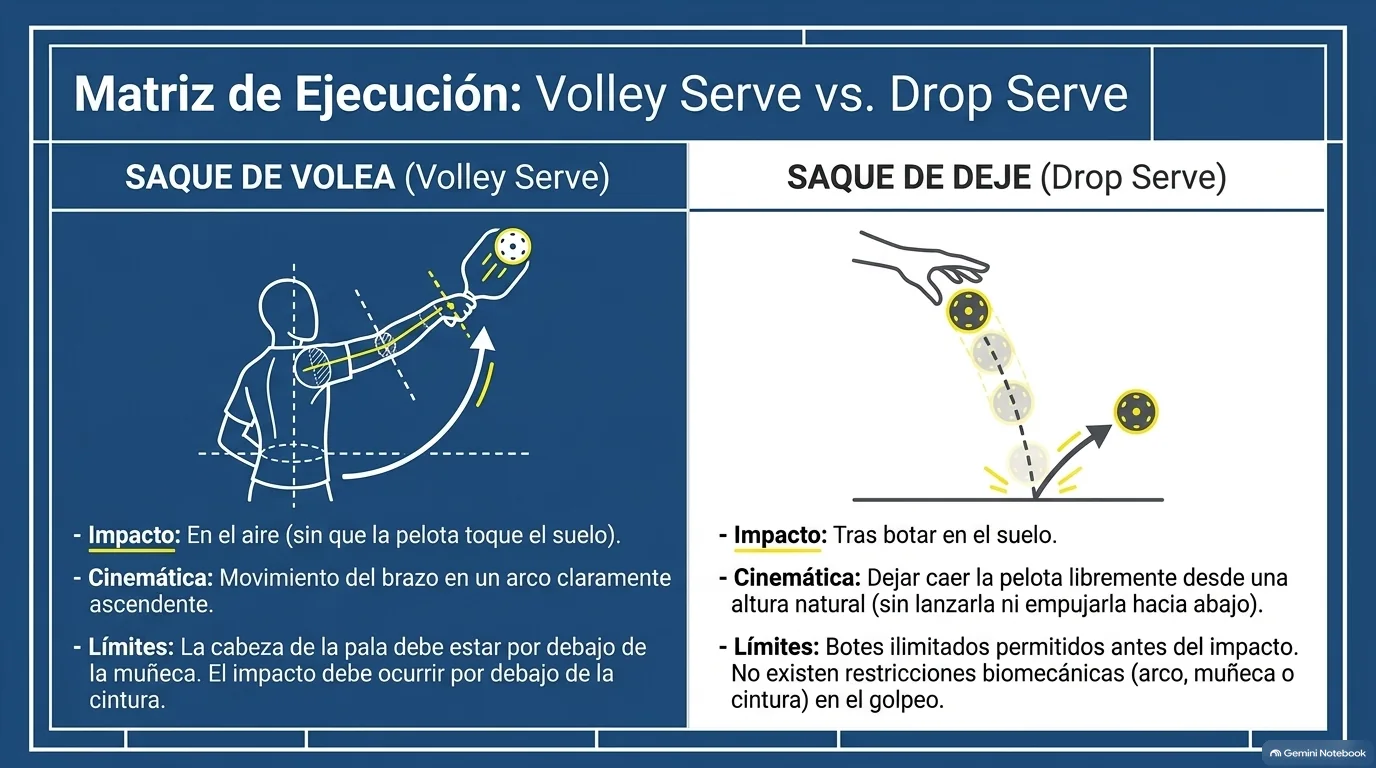
The serve may be a volley serve or a drop serve. The release must be visible, with no hand-applied spin. The ball travels to the diagonal service court and avoids the kitchen line.
- The volley serve retains the requirements for an upward arc, contact below the waist and the paddle head below the wrist.
- For a drop serve, release the ball without propelling it and strike it after the bounce.
- At least one foot touches the ground behind the baseline; neither foot touches the court or prohibited lateral extensions.
Situation → decision
The served ball touches the non-volley-zone line.
Fault: that line belongs to the non-volley zone.
Sections 6 and 7
A bounce on reception, a bounce on the first return
The two-bounce rule
After the serve, the receiving team lets the ball bounce; the serving team then lets the return bounce. Only after that may either team volley from a legal position.
- The two bounces are consecutive and belong to different teams.
- A deep lob on the return forces the serving team to wait for the bounce.
- Wheelchair play may allow two bounces per return under the adaptive section.
Situation → decision
The server’s partner intercepts the return of serve with a volley.
Fault by the serving team: the second compulsory bounce had not occurred.
Definition: two-bounce rule · Section 10
The kitchen, lines and faults
Take control of the rally
Decide confidently when you can volley, how to make a line call and which contacts end the rally.
You can stand inside; you cannot volley from inside
The non-volley zone
The kitchen does not prohibit entry. It prohibits volleying while the player, their equipment or the associated momentum maintains contact with it.
- The kitchen line is part of the zone.
- After a volley, you must regain your balance outside the zone.
- You may play a ball that has bounced inside and remain there until you leave with both feet.
Situation → decision
You volley outside, lose your balance and step into the kitchen after the opponent misses.
Fault: momentum from the volley continues even after the ball is dead.
Section 9
If you cannot clearly see out, the ball is in
Line calls
Each team calls the lines on its side honestly and promptly, giving the opponent the benefit of the doubt. Spectators do not intervene.
- To call out, you must see space between the ball and the line.
- Disagreement between partners is resolved as in.
- In officiated matches, intervention is requested through the permitted procedure.
Situation → decision
One player calls out and their partner says the ball touched the line.
In: disagreement between partners invalidates the out call.
Section 8
Contact, trajectory, net and body
Faults and dead balls
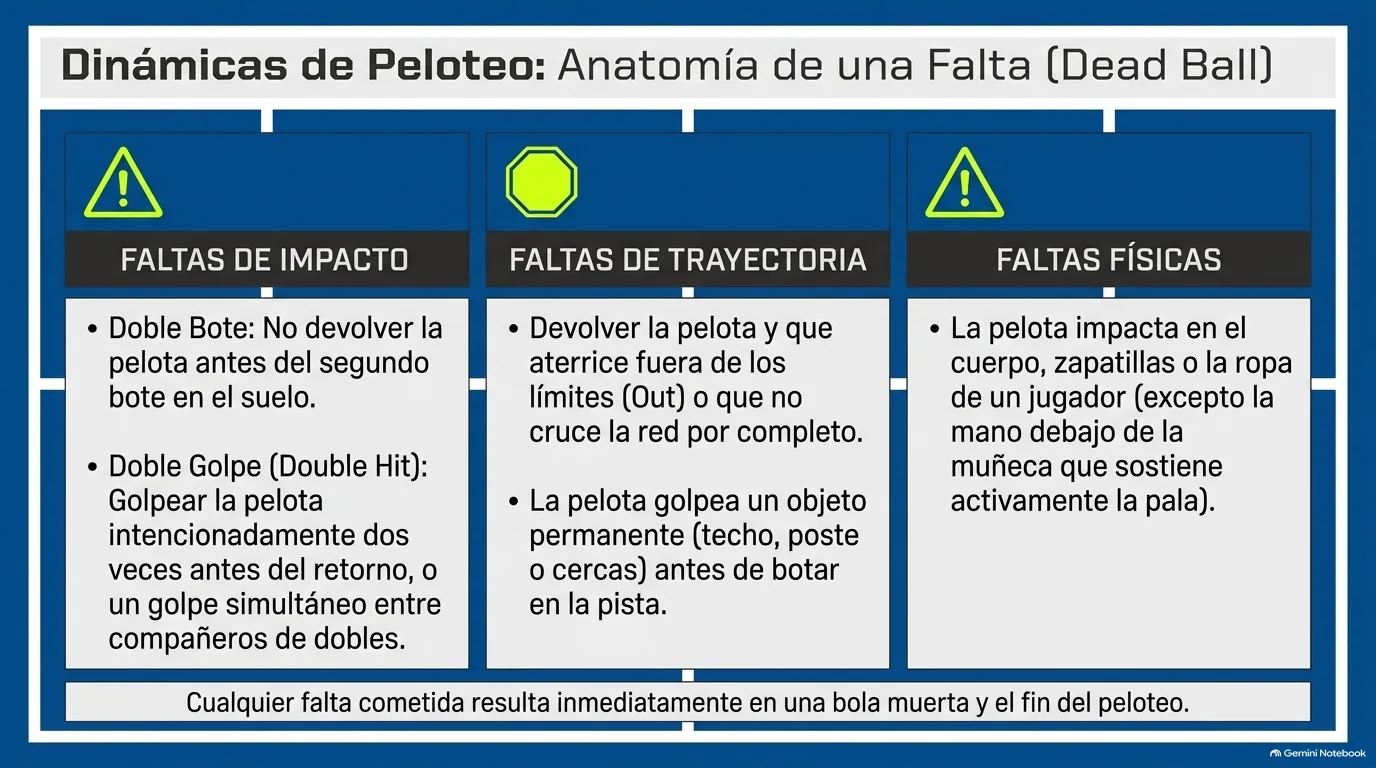
A fault ends the rally: a ball out, two bounces, an illegal serve, contact with a person or clothing, a deliberate double hit, failure to cross the net or contact with a permanent object before bouncing.
- The paddle hand below the wrist is considered part of the paddle while holding it.
- An unintentional, continuous double contact in one direction may be legal.
- A ball that touches the net during a rally remains live if it crosses and lands in.
Situation → decision
The ball brushes the paddle twice during a single continuous swing.
It may be legal if unintentional, continuous and in the same direction.
Section 10
When the match goes off script
Handle the unexpected
Distinguish a hinder from a distraction and respond to stray, damaged or extra balls without improvising.
Hinders, distractions, the net and damaged balls
Special situations
An unforeseen obstacle may justify replaying the point; a player-created distraction may be a fault. Damaged balls are checked after the rally unless there is an immediate risk.
- A ball from another court is a classic hinder.
- Spectators are not consulted to reconstruct a rally.
- Carrying or dropping an extra ball has a specific procedure in 2026.
Situation → decision
A stray ball enters the playing area during a rally.
Stop for safety and replay the rally when a hinder is declared.
Sections 10 and 24
Formats, officiating and adaptive play
Compete and include
Complete the journey by understanding who makes decisions, which competition provisions take precedence and how adaptations apply.
The published format takes precedence
Competition and officiating
Tournaments define the format, scoring, timeouts, draw and procedures. Officials handle penalties, appeals, medical timeouts and line rulings according to their level of authority.
- Read the briefing and event information before playing.
- PPA, MLP, RFET and other organisations may use different rules or formats.
- Serious misconduct may result in loss of a point or match, or expulsion.
Situation → decision
A league specifies rally scoring in its competition provisions.
That authorised competition format applies, rather than recreational side-out scoring by default.
Sections 14 to 22
Wheelchair and adaptive standing play
Adaptive play
The 2026 edition brings together specific criteria for wheelchair and adaptive standing play. The wheelchair is an extension of the body, and different bounce rules may apply.
- Safety and functional adaptation inform officiating decisions.
- The second wheel may cross certain boundaries only in authorised situations.
- Confirm the classification and applicable modifications before the match.
Situation → decision
A wheel touches the kitchen line during momentum from a volley.
It is assessed as contact by the body with the non-volley zone.
Section 25
Final practice
Recall, decide, check
Ten flashcards and a complete quiz turn what you read into decisions on court. Individual answers are not stored.
What changes in 2026
29 updates, clearly explained
Now that you know the basics, compare the 2026 edition. Each entry keeps its proposal number, practical impact and section reference.
Play
4 changesServe
4 changesScoring
2 changesOfficiating
10 changesCompetition
6 changesInclusion
3 changesExplore further
Read, connect and consult
Accessible articles, an expandable mind map and a definitions table help you revisit concepts while following the learning journey.
Reading
Report, study and application
Three articles adapt the notebook material into accessible web content with a clear structure, without needing Google.
Mind map
Rules as a sequence
Open each branch to follow the game from preparation through competition and adaptations.
2026 pickleball rules
Decide in order: before the serve, serving, two bounces, rally and conclusion.
Court, equipment, score, positions and the not-ready signal.
Court and lines
20 × 44 feet; a line belongs to the area it defines.
Score
Check the format, score and correct server.
3. Two bounces
The serve bounces, then the serving team lets the first return bounce.
Reference table
Definitions for making decisions
Read on screen or download the original Spanish CSV to prepare sessions, cards and your own material.
Definitions in practical language. For a dispute or competition, always check the full definition in the official rulebook.
Rally
The sequence from the serve until the ball is dead.
Think of it as one complete unit of play.
Definitions
Volley
Hitting the ball before it bounces.
Check your feet and momentum in relation to the kitchen.
9.B.1
Non-volley zone
The area extending 7 feet on each side of the net, including its lines.
You can enter, but you cannot volley from there.
Section 9
Volley serve
A serve struck before the ball touches the ground.
Check the arc, contact height and paddle position.
Section 7
Drop serve
A serve struck after letting the ball bounce.
Drop it without throwing it or pushing it down.
Section 7
Fault
A breach that ends the rally or triggers a penalty.
Identify who, when and with what consequence.
Section 10
Dead ball
A ball that is no longer in play.
Do not confuse the end of the rally with the end of momentum from a volley.
Definitions
Hinder
An external obstacle affecting play.
Stop for safety and replay if appropriate.
Definitions
Distraction
An action by a player that interferes in a way unrelated to normal play.
It may result in a fault against the distracting player.
Definitions
Side out
Loss of the service turn to the opponent.
In doubles, it usually follows the loss of the available service turns.
Section 4
Rally scoring
A format in which each rally may produce a point.
Use it only when the event provisions specify it.
Section 14
Disagreement between partners
Partners disagree on a line call.
The ball is considered in.
8.H
| Term | In practical language | Decision cue | Reference |
|---|---|---|---|
| Rally | The sequence from the serve until the ball is dead. | Think of it as one complete unit of play. | Definitions |
| Volley | Hitting the ball before it bounces. | Check your feet and momentum in relation to the kitchen. | 9.B.1 |
| Non-volley zone | The area extending 7 feet on each side of the net, including its lines. | You can enter, but you cannot volley from there. | Section 9 |
| Volley serve | A serve struck before the ball touches the ground. | Check the arc, contact height and paddle position. | Section 7 |
| Drop serve | A serve struck after letting the ball bounce. | Drop it without throwing it or pushing it down. | Section 7 |
| Fault | A breach that ends the rally or triggers a penalty. | Identify who, when and with what consequence. | Section 10 |
| Dead ball | A ball that is no longer in play. | Do not confuse the end of the rally with the end of momentum from a volley. | Definitions |
| Hinder | An external obstacle affecting play. | Stop for safety and replay if appropriate. | Definitions |
| Distraction | An action by a player that interferes in a way unrelated to normal play. | It may result in a fault against the distracting player. | Definitions |
| Side out | Loss of the service turn to the opponent. | In doubles, it usually follows the loss of the available service turns. | Section 4 |
| Rally scoring | A format in which each rally may produce a point. | Use it only when the event provisions specify it. | Section 14 |
| Disagreement between partners | Partners disagree on a line call. | The ball is considered in. | 8.H |
Common questions
Questions about the 2026 pickleball rules
Manual revision log
Revisions to the 2026 edition
Future editions will have their own URL. This page preserves the context and corrections for 2026.
- v1.1
New learning journey with five missions, account-based practice and local progress.
- v1.0
Initial publication based on the official 2026 rulebook and change document.
Next review: when USA Pickleball publishes an official correction or a relevant interpretation.
Official sources and scope
Always check the source
Our guide is original educational material. If there is any difference, the official English rulebook and the competition’s conditions take precedence. Last checked: 2 September 2026.